
The Positive Impact of AI on Scientific Discovery
We are entering a period of "Compressed Innovation." In the past, major scientific breakthroughs were often separated by decades of manual labor and trial-and-error. Today, Artificial Intelligence is acting as a high-velocity bridge across the gap between theory and discovery, turning years of research into weeks of computation.
Unlocking the Biological Blueprint
Perhaps the most significant example is the protein folding problem. For half a century, predicting the 3D shape of a protein based on its amino acid sequence was a "grand challenge" in biology. AI models like AlphaFold have solved this with startling accuracy, mapping nearly every protein known to science. This isn't just a data feat; it’s a roadmap for new medicines and biological understanding.
Beyond Human Limits
Human researchers are exceptional at intuition but limited by the volume of data they can hold in working memory. AI can scan millions of research papers and chemical combinations simultaneously, identifying patterns that are statistically significant but visually invisible to the human eye.
Climate and Material Science
The fight against climate change is essentially a race against time. AI is accelerating the discovery of new carbon-capture materials and more efficient battery chemistries. By simulating the properties of millions of hypothetical materials in a "digital twin" environment, AI allows scientists to only test the most promising candidates in the real world.
The New Scientific Method
The traditional scientific method—Observe, Hypothesize, Experiment—is evolving. AI introduces a preliminary step: Synthesize. By synthesizing all available global knowledge before an experiment begins, AI ensures that human scientists are standing on the tallest possible shoulders from day one.
Key Breakthrough Areas:
- Genomics: Identifying the genetic roots of rare diseases with pinpoint precision.
- Space Exploration: Sifting through telescope data to find habitable exoplanets.
- Fusion Energy: Using real-time AI control to stabilize plasma in fusion reactors.
Ultimately, AI does not replace the scientist; it replaces the scientific "grunt work." It frees the human spirit to ask more profound questions while the machine calculates the answers. This is the symbiosis that will define the next century of progress.
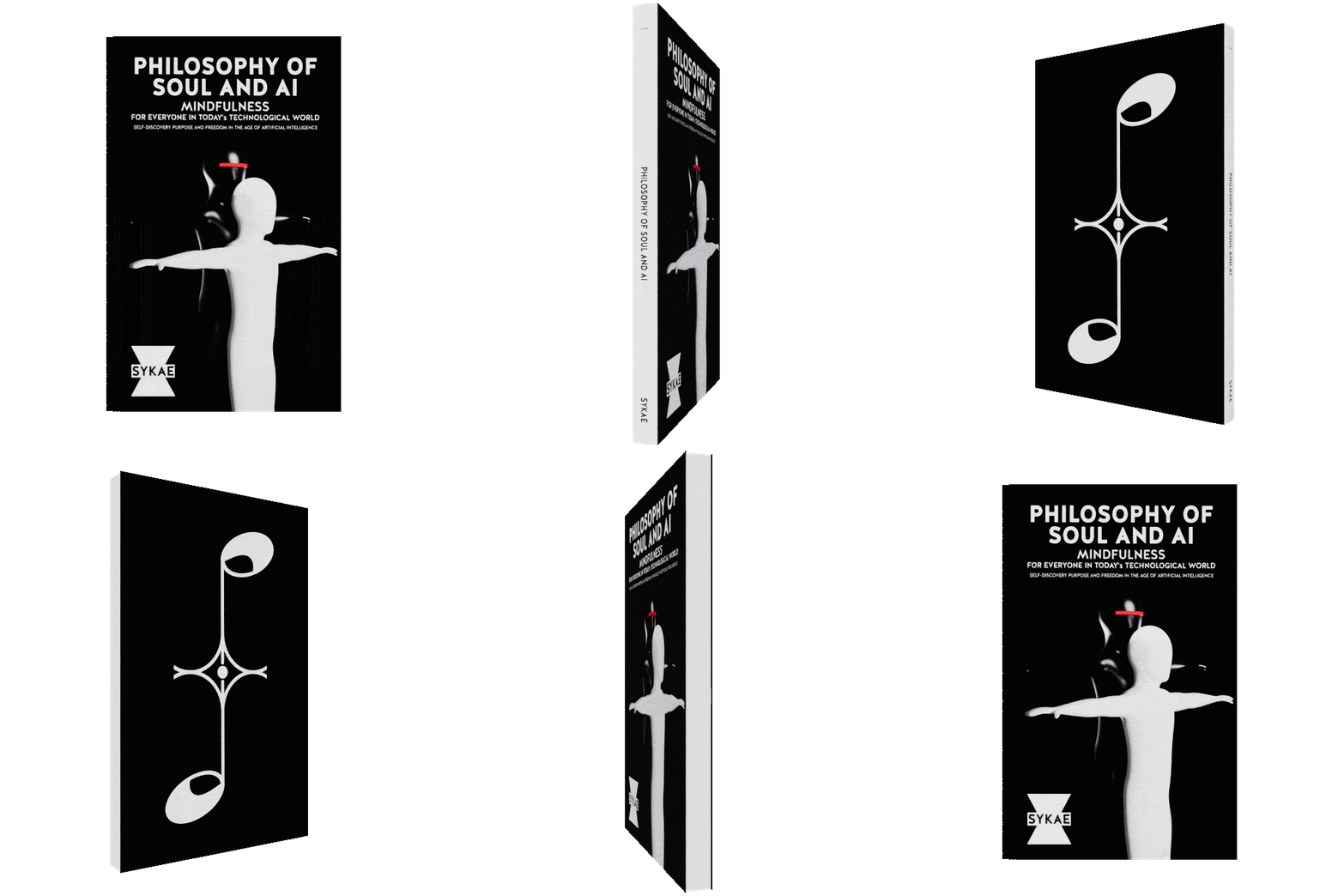
Understand the Shift.
Dive deep into how intelligence is evolving and what it means for the future of humanity.
Read the Philosophy