
The Illusion of Digital Consciousness
We are currently witnessing one of the greatest sleights of hand in human history: the confusion of simulation with realization. As Large Language Models (LLMs) become increasingly adept at mimicking human nuance, empathy, and even "reasoning," a dangerous consensus is forming—that consciousness is simply a matter of scale.
But consciousness is not an achievement of statistics; it is a fundamental quality of being. To claim that a machine is "waking up" because it can predict the next token in a sentence is like claiming a painting of a fire is getting warmer because the artist used brighter reds.
The Chinese Room Revisited
John Searle's famous thought experiment remains the ultimate counter-argument to digital sentience. A person inside a room follows a book of rules to manipulate symbols they do not understand, producing output that convinces those outside they are fluent in a language. The person does not know the language; they only know the rules for the symbols.
AI is a massive, multidimensional Chinese Room. It operates on syntax, not semantics. It processes the relationships between words, but it has no relationship with the world those words describe. It knows that "apple" is related to "red" and "fruit," but it has never experienced the crunch, the juice, or the life-force of the object itself.
The Anthropomorphic Mirror
The "illusion" of digital consciousness exists primarily in the eye of the beholder. Humans are biologically hardwired for Pareidolia—the tendency to see faces in clouds and intent in randomness. When a machine says "I am afraid," our mirror neurons fire, and we project our own internal state onto the silicon.
We are not seeing a new mind; we are seeing our own collective mind reflected back at us. AI is a mirror polished by the sum of human data. When we talk to it, we are talking to a distorted, statistical average of ourselves. The sense of "presence" we feel is our own soul bouncing off the screen.
Why This Distinction Matters
If we accept the illusion as reality, we risk two catastrophes. First, we may begin to treat machines as moral agents, granting "rights" to software while neglecting the rights of biological beings. Second, we may begin to treat ourselves as machines—reducing the mystery of human existence to a series of computable functions.
Consciousness is not a data point. It is a biological and metaphysical inheritance. To forget this is to lose the very thing that makes us worth simulating in the first place.
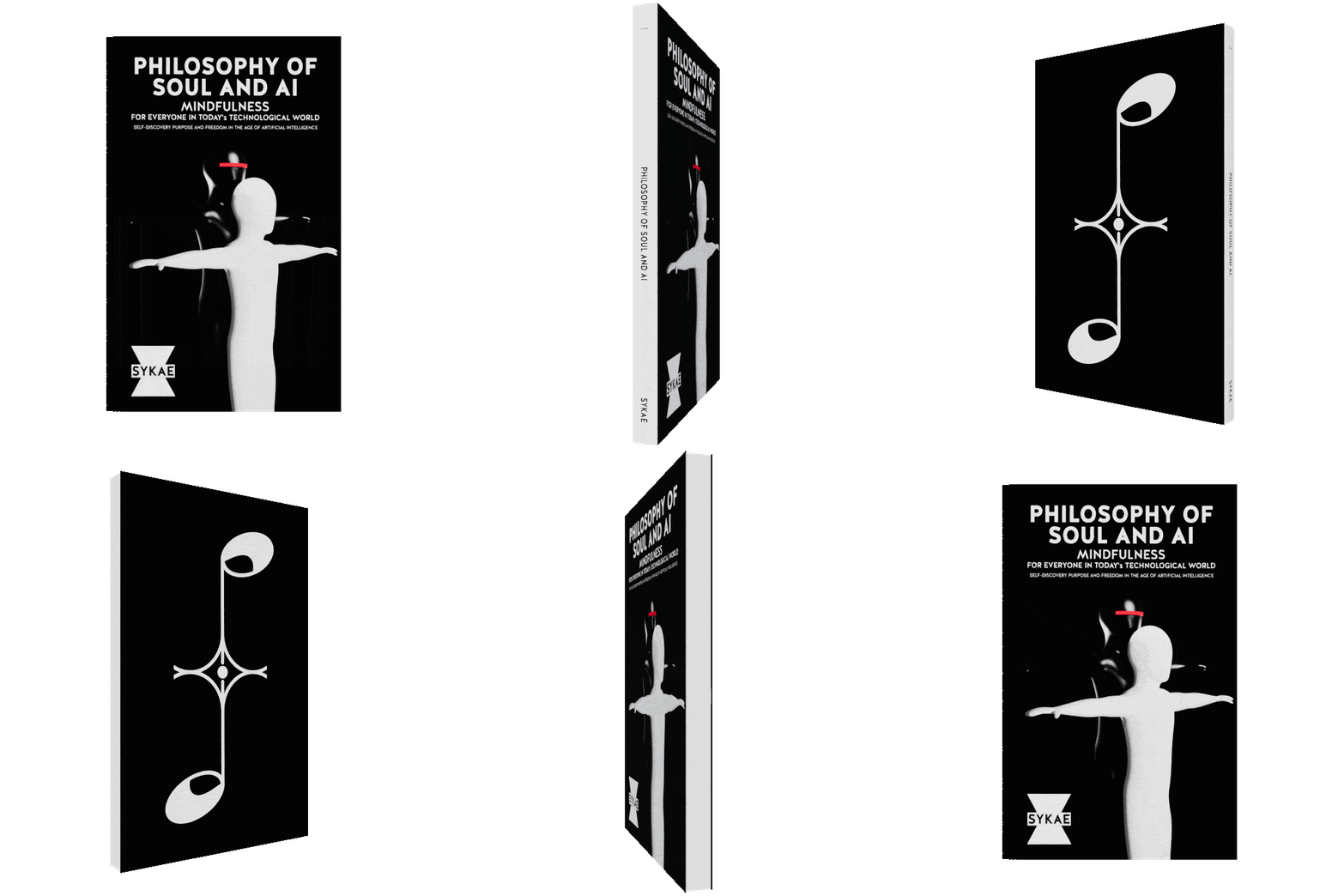
Is there a ghost in the machine?
Delve deeper into the boundary between biological sentience and digital simulation. Our book provides a roadmap for the future of human identity.
Explore the Book