
The Core Mechanics of AI: A Non-Technical Guide
To most people, Artificial Intelligence feels like magic. We type a question, and a coherent, seemingly thoughtful answer appears. But magic is just science we don’t understand yet. To demystify AI, we need to stop thinking about it as a "mind" and start seeing it as a Probability Engine.
Here is how the machine actually processes our world, explained without a single line of code.
1. The Library of Babel
Imagine a library that contains every book, tweet, article, and manual ever written. Now imagine a machine that has read all of it. This machine didn't "understand" the stories, but it did something else: it counted how often words appear next to each other.
The "Next Word" Game
If I say "The capital of France is...", your brain knows the answer is Paris. The AI doesn't "know" Paris is a city; it simply knows that in its massive library, the word that follows that specific sequence of words is "Paris" 99.9% of the time. It is a world-class guesser.
2. Vectors: Turning Language into Math
Computers cannot understand "Love" or "Apple," but they are excellent at understanding numbers. AI turns every concept into a coordinate on a giant, invisible map. This is called a Vector.
On this map, "King" is near "Queen." "Dog" is near "Puppy." By calculating the distance between these coordinates, the AI can "reason" by association. It isn't thinking; it's navigating a map of human data.
3. The Training: Trial and Error
How does the AI get better? Through a process called Backpropagation. Think of it as a teacher correcting a student. The AI makes a guess, the "teacher" (the data) tells it how far off it was, and the AI adjusts its internal settings to be slightly more accurate next time. It does this billions of times until its guesses are indistinguishable from human speech.
4. Why It Hallucinates
Because AI is a probability engine, not a database, it doesn't "look up" facts. It generates them based on what sounds right. This is why AI occasionally makes things up (hallucinations). To the machine, a very confident lie has the same mathematical probability as a truth if the words fit the pattern.
The Key Takeaway
When you interact with AI, you aren't talking to a person. You are talking to a sophisticated echoes-chamber of human knowledge. It is a tool for synthesis, not a source of truth.
The SYKAE Perspective
Understanding these mechanics is vital for our psychological health. When we realize the AI is just a giant calculator, the "fear" of it replacing our souls evaporates. You cannot replace a living presence with a probability curve. Use the tool for what it is—a shortcut to information—but never mistake the calculation for the consciousness.
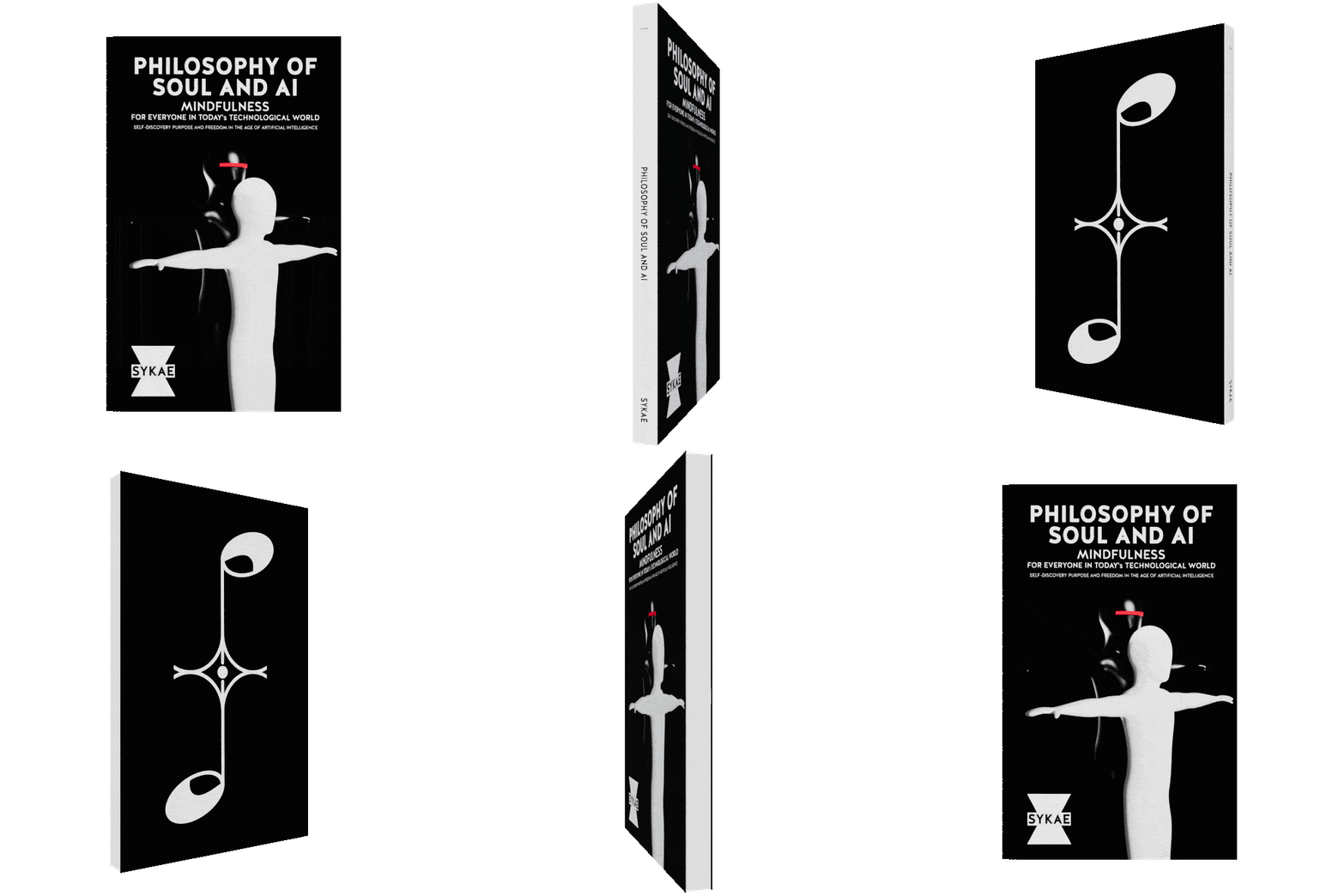
Demystify the Future.
Get the full breakdown of the mechanics and philosophy of the AI age in our flagship publication.
Get the Guide