
Can AI Help Us Understand Our Own Consciousness?
For centuries, the "Hard Problem" of consciousness—how physical matter gives rise to subjective experience—has been the exclusive domain of philosophers and theologians. However, as we build increasingly complex Artificial Intelligence, we are inadvertently building a mirror. By observing what AI can do without consciousness, we are finally beginning to isolate what consciousness actually is.
The Via Negativa of the Mind
In theology, the via negativa is a way of describing something by explaining what it is not. AI provides this for the human soul. We used to think that logic, calculation, and even language were the hallmarks of consciousness. Today, large language models (LLMs) prove that you can have world-class intelligence and language processing without a single spark of subjective "feeling."
The Difference Between Calculation and Sentience
An AI "calculates" the probability of a word; a human "feels" the weight of a sentence. By stripping away the tasks that machines can perform, we are left with a smaller, more mysterious core of human-ness: the raw, qualitative experience of being alive (Qualia).
Reverse-Engineering the "I"
Neural networks are loosely modeled on the human brain. As we tweak these architectures to improve reasoning, we encounter "emergence"—behaviors that aren't programmed but arise from complexity. Studying these emergent properties helps neuroscientists identify which structures in the human brain might be responsible for our own sense of self-governance and internal narrative.
The Boundary of the Ghost
Perhaps the greatest contribution of AI to our self-understanding is the realization that intelligence and consciousness are separate axes. A machine can have infinite intelligence with zero consciousness. This suggests that consciousness isn't just "more smarts"; it is a different biological or metaphysical layer entirely.
Emergent Insights:
- Integrated Information Theory: Using AI models to test how information "wholeness" relates to awareness.
- Predictive Processing: Understanding our brain as a "prediction engine" by comparing it to generative AI.
- The Ego-Boundary: Discovering why humans have a "sense of self" that machines currently lack.
Ultimately, AI may never become "conscious" in the way we are, but in the process of trying to build it, we are mapping the geography of our own souls. We are the architects who, by building a statue, finally understand the miracle of the breath.
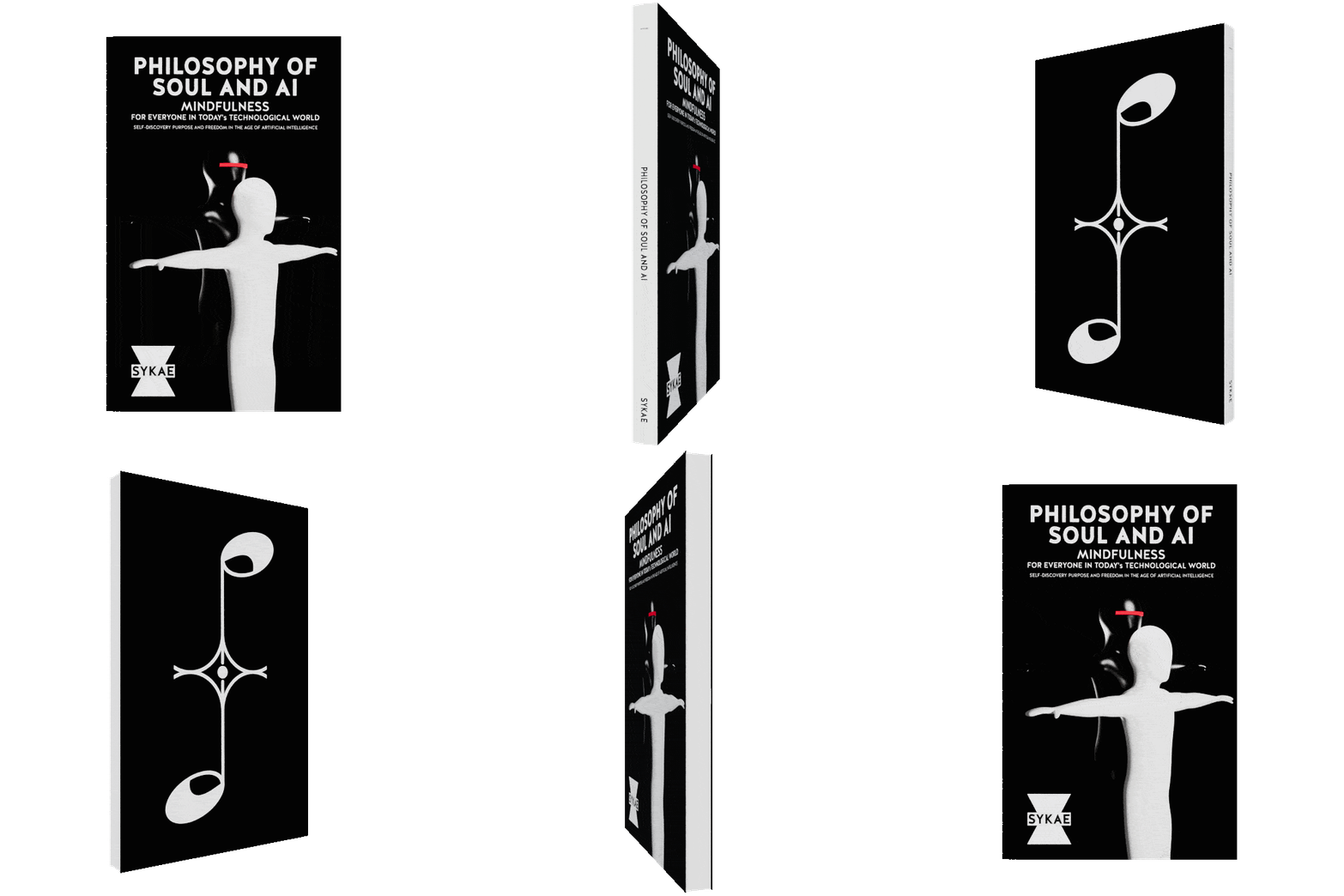
The Final Frontier.
Deepen your understanding of the intersection between synthetic intelligence and human spirit.
Read the Manual