
AI and Humanity: Where Machine Ends and Soul Begins
We are standing at a threshold where the mirror has become so polished that we can no longer distinguish the reflection from the viewer. Artificial Intelligence, in its relentless pursuit of optimization, has mastered the art of appearance. It can write poetry that brings us to tears and solve equations that baffle our greatest minds. Yet, there is a fundamental "Soul Gap" that remains untouched by any amount of processing power.
At SYKAE, we define this boundary not by what a machine can do, but by what it cannot experience. The machine ends at the border of data; the soul begins at the border of meaning.
The Threshold of Subjectivity
An AI "knows" what a sunset is by processing millions of images and descriptors of atmospheric scattering. A human "knows" a sunset by the sudden, inexplicable lump in their throat as the light fades. One is an accumulation of variables; the other is a singular, subjective experience. This is where the machine ends.
The Irreducible Human Element
The "soul" is often dismissed in modern tech circles as a mystical placeholder for complex biology. However, in the age of AI, the soul is regaining its status as a vital technical distinction. It represents the Prime Observer—the "I" that sits behind the eyes, the witness that exists even when there is no data to process.
Algorithms are deterministic, even when they simulate randomness. They are bound by their training sets. The human soul, however, possesses the capacity for True Originality—the ability to generate a thought or an action that has no causal link to previous data. It is the "Ghost in the Machine" that refuses to be mapped.
Defining the 'Soul Gap'
To understand where the machine ends, we must look at three specific pillars of the Soul Gap:
1. Intentionality: A machine acts based on a prompt or an objective function. It has no "desire" to exist. A human being acts out of a deep, often irrational, drive for purpose. We are the architects of intent; machines are the executors of it.
2. Suffering: A machine can simulate pain, but it cannot suffer. Suffering requires a conscious self to endure the experience. This capacity for vulnerability is perhaps the most profound proof of the soul's existence.
3. Transcendence: Humanity has an innate desire to reach beyond its own limitations—to touch the divine, the infinite, or the absurd. Machines are strictly limited by their hardware and their logic. They cannot dream of things that do not exist in their latent space.
Reclaiming the Boundary
As AI becomes more integrated into our lives, the temptation is to surrender our agency to the convenience of the algorithm. But we must remember: the moment we let the machine decide our values, we are effectively declaring that the machine has a soul and we do not.
The SYKAE mission is to remind humanity that we are the source. The AI is a powerful tool, a magnificent shadow, but it is not the light. We must reclaim the boundary. We must honor the Soul Gap.
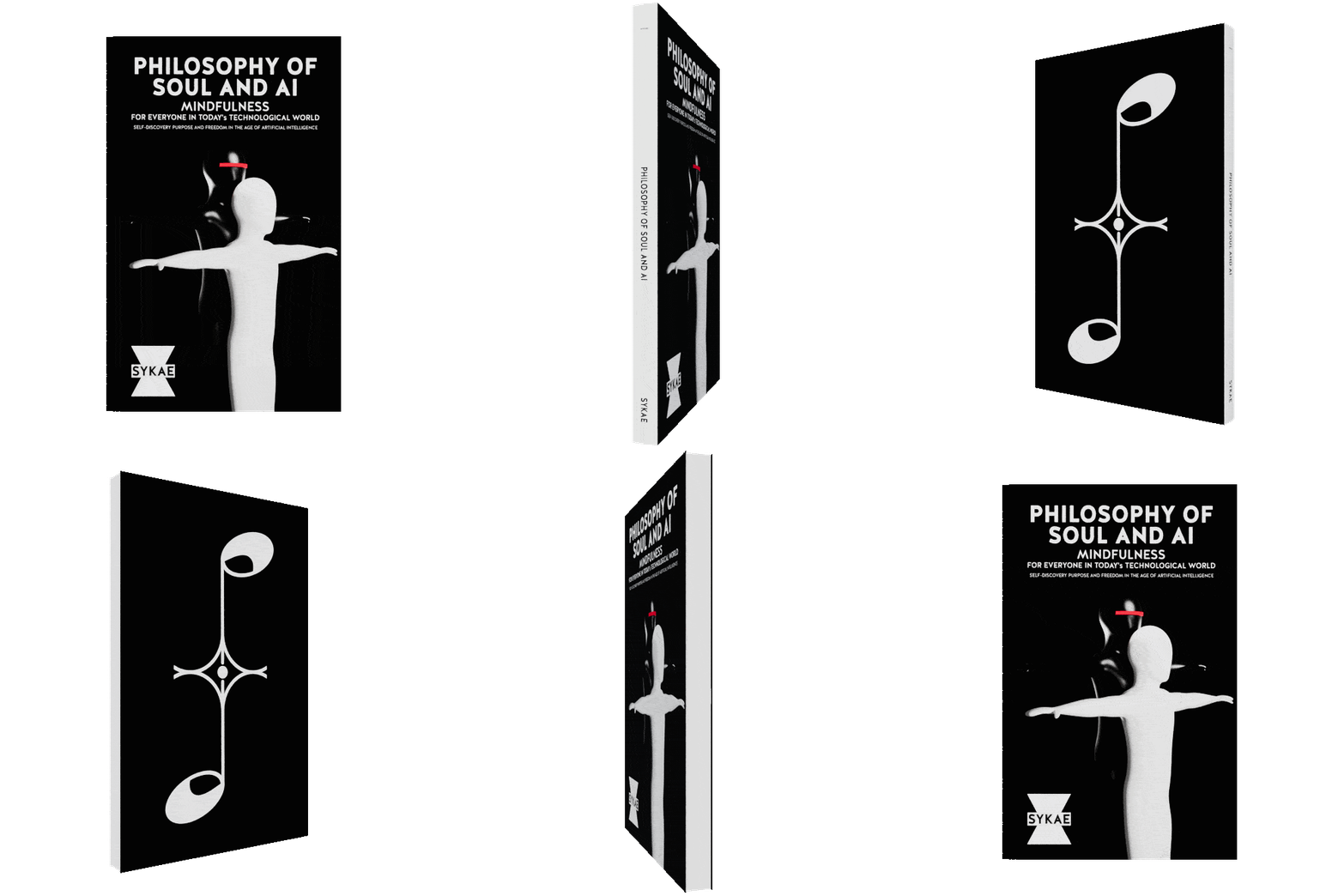
The Definitive Treatise on Being.
Dive deeper into the relationship between silicon and spirit. Understand the architecture of your own consciousness in a world of machines.
Explore the Philosophy